
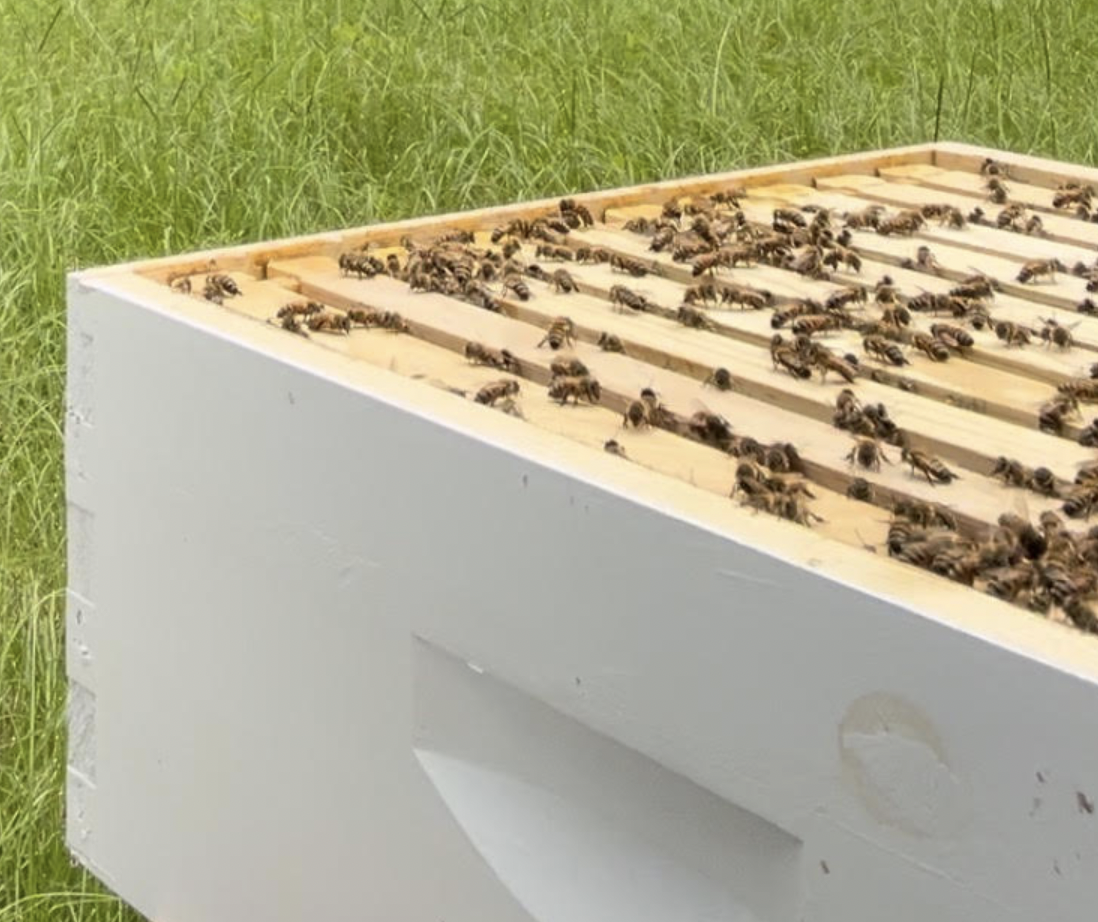
This is my third year of beekeeping, and I think I’m finally starting to feel like I know what I’m doing. A little. Most days.
The biggest lesson of those three years — the one I seem to relearn every season — is that the bees are in control. I am not. I’m here to offer them support, to read what they’re telling me, and to stay out of their way when that’s the right move. I’ve stopped trying to manage a hive like it’s a project with a deadline and started treating it more like a conversation. Slower, quieter, and honestly a lot more successful.
Winter was gentle, because the bees were ready
Late last fall, I combined our two hives into one — a move that sounds dramatic but is actually a pretty standard choice when one colony is weaker than the other heading into the cold months. The stronger hive absorbs the weaker, and everybody has a better shot at making it through winter.
It worked. The combined colony came into winter with a bustling population and plenty of honey reserves, which meant my job for a few months was mostly to get out of the way. Periodic checks on warmer days — eyes on food stores, looking for anything off — but nothing urgent. When a hive is well-provisioned and has a healthy queen, winter beekeeping is mostly a lot of not interfering.
Splitting back into two
As spring crept closer, the hive started doing what healthy hives do in early spring: expanding, fast. The queen’s laying picked up, the population swelled, and the signals started pointing toward a swarm.
A swarm is, essentially, the bees’ own version of a split — they raise a new queen, and then roughly half the hive leaves with the old one to start fresh somewhere else. Beautiful in principle. Expensive in practice, because that’s half my bee population flying off to some stranger’s tree.
So I beat them to it. I split the hive back into two colonies — one gets the existing queen, one raises a new one — and everyone stays on the farm. It’s one of the more nerve-wracking things a beekeeper does, because if you time it wrong or handle it poorly, you can lose both halves. Timed right, you end up exactly where I ended up: two happy, healthy hives, each with a laying queen.
Where things stand now
Both hives are in good shape. I’m seeing lots of pollen coming in on the workers’ back legs — those bright yellow and orange dustings that tell me the girls are foraging hard and the queens are laying. Good signs across the board.
The one challenge: the same drought I’ve been writing about on the flower side of the farm is hitting the bees too. Fewer blooms mean less nectar, so I’m supplementing more heavily than usual with sugar water. It’s a decent mimic of nectar and keeps the colonies building, but it’s not a replacement for the real thing. A few good rainy days would go a long way — for the flowers, for the bees, for all of it.
More updates as the season unfolds. For now, the hives are humming, and I’m reminded again that my job here is to pay attention.